
Under climatic conditions, where the heating season lasts an average of six to seven months per year, floor insulation is one of the most critical pillars of a building’s energy efficiency. Whether planning floor insulation in a new build or carrying out a building renovation, improperly selected thermal insulation can covertly cause immense heat loss, acoustic discomfort, and even structural damage.
How does the Austrian-developed ThermoWhite® bound EPS seamless system fundamentally change floor construction standards?
A Problem Often Ignored in Construction: Theory vs. Practice
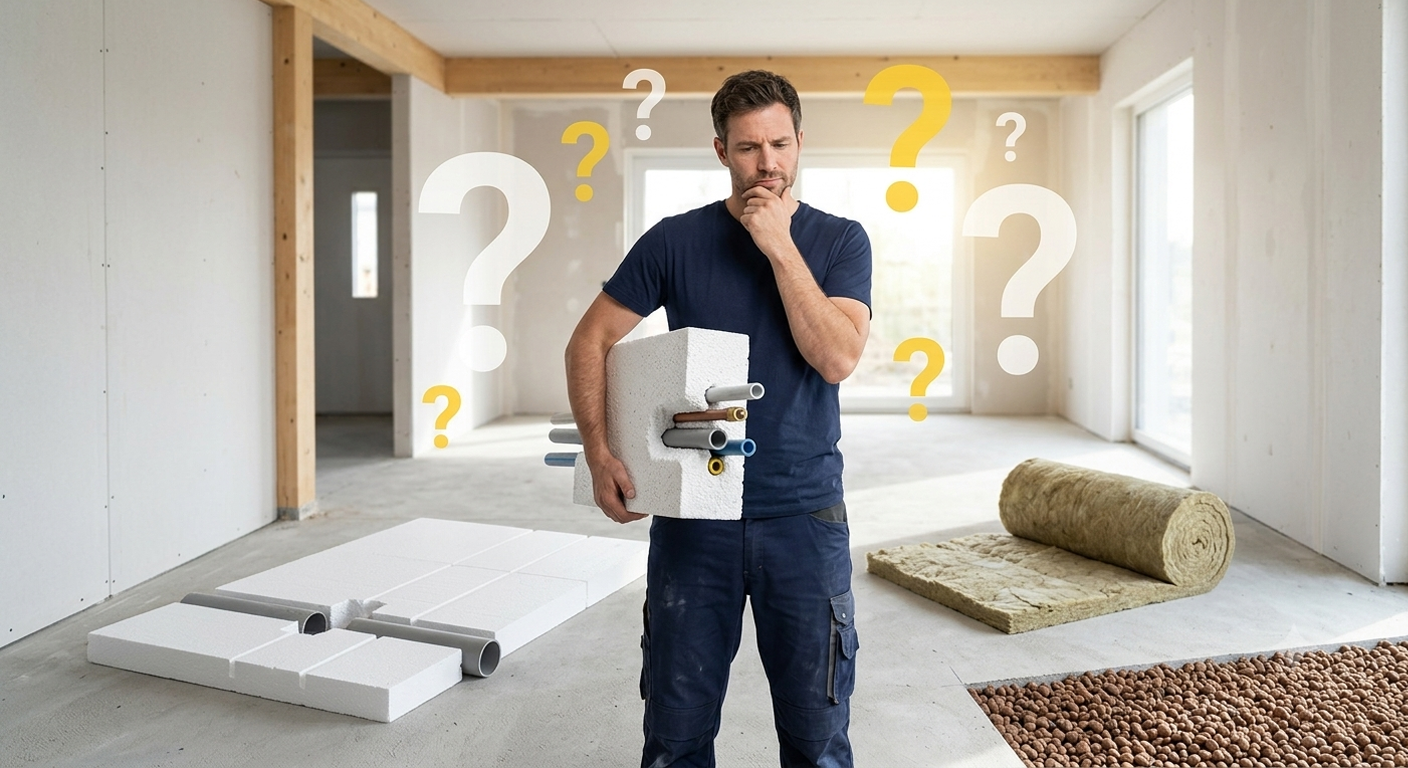
On paper during the design phase, everything looks flawless. A designer specifies, for example, a 100 mm thick traditional EPS (expanded polystyrene) board with good thermal conductivity. However, the reality on the job site is different. Engineering utilities are almost always present on the floor base—heating pipelines, electrical cable conduits, and ventilation ducts.
Workers attempting to lay rigid insulation boards over these utilities are forced to constantly cut, break, and make cutouts in them.
What are the real-life consequences of this approach?
- Thermal Bridges (Cold Bridges): Every joint, gap, and cavity around utilities becomes a highway through which heat uncontrollably escapes into the base structure. Thermal imaging measurements show that the actual thermal transmittance of standard EPS boards on a construction site can be up to 39.9% worse than theoretically calculated.
- Acoustic Bridges and Impact Noise: Rigid pipelines lying unfastened under the boards or contacting the leveling concrete screed create a direct acoustic bridge. As a result, residents complain after just a few years about unbearable footstep noise from upper floors.
- Floor Cracking and Unevenness: Since the boards rest only on the highest points of the utility lines, voids remain underneath them. Under operational loads, the floor can settle, causing cracks in the concrete and even damaging the final finishes (doors, baseboards, furniture).
What is ThermoWhite and How Does It Solve These Problems?
ThermoWhite (also known as liquid polystyrene or bound EPS fill) is an innovative system manufactured in Austria and certified with a European Technical Assessment (ETA-12/0428). It consists of 100% recycled EPS granules and special mineral binders.
The material is prepared and delivered directly on-site using a mobile mixing plant (MixMobil). Its liquid, flowable consistency allows it to flow into all voids on its own, completely encapsulate pipelines and cable runs, and, upon curing, form a completely monolithic, dense, and seamless thermal insulation layer with high compressive strength.
Technical Parameters (ThermoWhite WD100R):
Thermal Conductivity: 0.046 W/mK. Because there are no joints or voids, thermal imaging measurements prove that its actual performance fully matches the theoretical value (deviation is less than 2.1%).
Impact Noise Reduction: Up to 25 dB (in accordance with EN ISO 10140-3). Combined with a concrete screed, it easily achieves the highest acoustic comfort Class A in accordance with the Latvian Building Regulation LBN 016-15.
Compressibility: 4.4 mm (at a 5 kPa load), meeting strict German DIN 18560-2 requirements, reducing load on the screed and allowing for thinner floor structures.
Time Efficiency: Traditional Method (168h) vs. ThermoWhite (24h)
Time is money—a rule felt acutely in construction. Traditional floor insulation is a lengthy, logistically complex 10-step process that typically takes an average of 168 hours (one week):
- Scope of work definition and site survey.
- Cost estimate and material ordering.
- Travel to the building supplies store.
- Material delivery to the site and logistics.
- Material unloading.
- Material storage (requires a dry room, protection from theft/moisture).
- Application of additional leveling layers if the base is uneven.
- Manual cutting and fitting of boards.
- Inspection, handover, and offcut waste disposal.
- Payment.
The ThermoWhite® 5-Step Method within 24 Hours:
By choosing ThermoWhite, the process is streamlined to a minimum because the material operates like a “factory on wheels”—everything is mixed on-site and directly pumped into the property (capacity $500\text{–}800 \text{ m}^2$ per day):
- Site survey and technical node evaluation.
- Cost calculation (precise and transparent estimate).
- Material installation: No shopping, delivery, or storage required—the vehicle arrives, installs a monolithic layer within a day, and departs.
- Inspection and handover (after 24–48 hours, the material has cured and is ready for subsequent trades).
- Payment.
Thermowhite system works faster and more effective.
Financial Savings: How Fast Does ThermoWhite Pay Off?
High-quality floor insulation directly affects monthly operating expenses. Let’s consider an illustrative real-life example in Latvia:Premise: Private house, $120 \text{ m}^2$, heated by a heat pump or gas, heating season ~6–7 months.
| Indicator | Before High-Quality Insulation | After ThermoWhite Installation | Real Savings |
| Average monthly heating bill | €250 | €200 | -€50 every month |
| Heating season cost (7 months) | €1750 | €1400 | -€350 per season |
| Heat loss through the floor | ~15–20% | ~5–8% | Up to 12% lower energy use |
| Air temperature stability | Fluctuations / cold spots | Stable, uniform, warm surface | Maximum comfort gain |
Financial Return: With an average savings of €300–400 per year, the initial investment in the ThermoWhite system pays for itself within 4–6 years. Afterwards, the system continues to generate net financial gains every winter while extending the operational lifespan of the entire heating system, as it doesn’t need to run at maximum overload.
Detailed Comparison: ThermoWhite vs. Other Materials
To better understand the return on investment, let us examine how ThermoWhite compares against other popular floor insulation materials:
| ThermoWhite | Mineral Wool | Expanded Clay (Keramzit) | Standard EPS (Boards) | |
| Monolithic layer without joints | YES (Fully monolithic) | NO (Many joints) | NO (Loose, binder-free) | NO (Micro-gaps form) |
| Thermal insulation efficiency | Excellent (Actual = Theoretical) | Good (But moisture sensitive) | Weak (Requires large thickness) | Variable (Practice loses ~40% vs theory) |
| Sound / Impact noise insulation | YES (Class A acoustic level) | YES | Partially | Partially (Worse around pipes) |
| Adaptability to utilities | Perfect (Flows around & envelopes) | Difficult (Requires cutting/gaps) | Good (Settles around them) | Very difficult (Air pockets form) |
| Fire resistance | YES | YES | YES | NO |
| Construction waste / Offcuts | 0% (Mixed to exact volume) | Yes (Offcuts) | 0% |
Significant (Foam scrap & offcuts) |
Sustainability and Green Building
Modern construction standards and European regulations demand not only energy efficiency but also a low environmental impact. ThermoWhite is a prime circular economy product—it is based on 100% recycled expanded polystyrene.
By choosing this system over conventional EPS boards, environmental impact is reduced across all metrics:
- 75% less photochemical ozone creation.
- 54% lower primary energy consumption during production.
- 21% lower $\text{CO}_2$ emissions.
- Zero site waste (offcuts), as precisely the amount of material required for the specific floor area is produced.
Summary
Floor insulation is no place for compromises or short-term savings. Every ignored void, incorrectly cut board, or acoustic defect will cost far more to rectify in the future than performing the work correctly from the start.
The ThermoWhite® bound seamless system provides the perfect balance between superior thermal retention, excellent sound insulation (Class A), and maximum site execution speed, making it the premier choice for modern new builds and historic renovations alike.
Want to calculate exact costs for your project? Our specialists will prepare an individual cost estimate!
👉 Fill out the application form and receive your quote here!
Frequently Asked Questions about Floor Insulation with ThermoWhite® (FAQ)
1. What exactly is ThermoWhite® and how does it differ from standard liquid foam?
Answer: ThermoWhite® is an Austrian-patented and European-certified (ETA-12/0428) system of bound EPS granules and special mineral binders. Unlike uncontrolled “DIY” mixtures or standard liquid foam, ThermoWhite is prepared using a computerized mobile plant on wheels (MixMobil). This guarantees consistent material density, high compressive strength ($\ge 70 \text{ kPa}$), and precise thermal insulation values that will not settle or deform over time.
2. Is the ThermoWhite® system suitable for floors with hydronic radiant heating pipes?
Answer: Yes, this is one of the material’s greatest advantages. As ThermoWhite is a fluid mass, it completely surrounds and encapsulates all engineering utilities (water, heating pipes, and cables) during installation, leaving no air pockets or voids. Radiant floor heating pipes are then fastened directly over the cured ThermoWhite layer (using system film and staples or drywall profiles) prior to pouring the concrete screed (estrich).
3. What is the recommended application thickness for ThermoWhite®?
Answer: The minimum recommended installation thickness to fully cover utilities is approximately 3–4 cm. The maximum thickness is practically unlimited because the material is lightweight and does not overload structural slabs. Typically, on ground floors of residential houses (slab-on-grade), a thickness of 10–20 cm is applied for optimal thermal insulation, while inter-floor slabs use 5–10 cm for sound and impact noise attenuation.
4. Why is ThermoWhite® a better choice between building stories than standard polystyrene boards?
Answer: The primary reason is impact noise insulation. Standard rigid EPS boards that are manually cut around pipes create gaps and hard contact points (sound bridges). ThermoWhite creates a completely seamless, resilient monolithic layer that dampens impact noise by up to 25 dB. This enables the building to easily achieve the highest acoustic comfort Class A according to Latvian Building Regulation LBN 016-15.
5. How quickly can floor construction resume after laying ThermoWhite®?
Answer: The material cures very rapidly. It is safe to carefully walk on the installed ThermoWhite® surface after just 24 hours (at an average ambient temperature of $+20^{\circ}\text{C}$ and ~70% relative humidity). The leveling concrete layer (estrich or self-leveling compound) can typically be applied after 48 hours, significantly accelerating the overall construction schedule compared to traditional methods.
6. Is ThermoWhite® fire-safe and environmentally friendly?
Answer: Yes. In accordance with European standards, ThermoWhite is classified as fire-safe (it does not support combustion). Environmentally, it is a true circular economy product—manufactured using 100% recycled EPS granules. Compared to conventional board manufacturing, ThermoWhite generates 21% fewer $\text{CO}_2$ emissions and consumes 54% less primary energy. Furthermore, it generates 0% construction waste on-site, as the exact volume needed is produced.
7. How can I obtain pricing for a ThermoWhite® installation for my property?
Answer: Costs are calculated individually based on the insulation area (square meters), desired layer thickness, and project location. To receive an accurate and transparent quote within a few days, visit our section and submit an application.